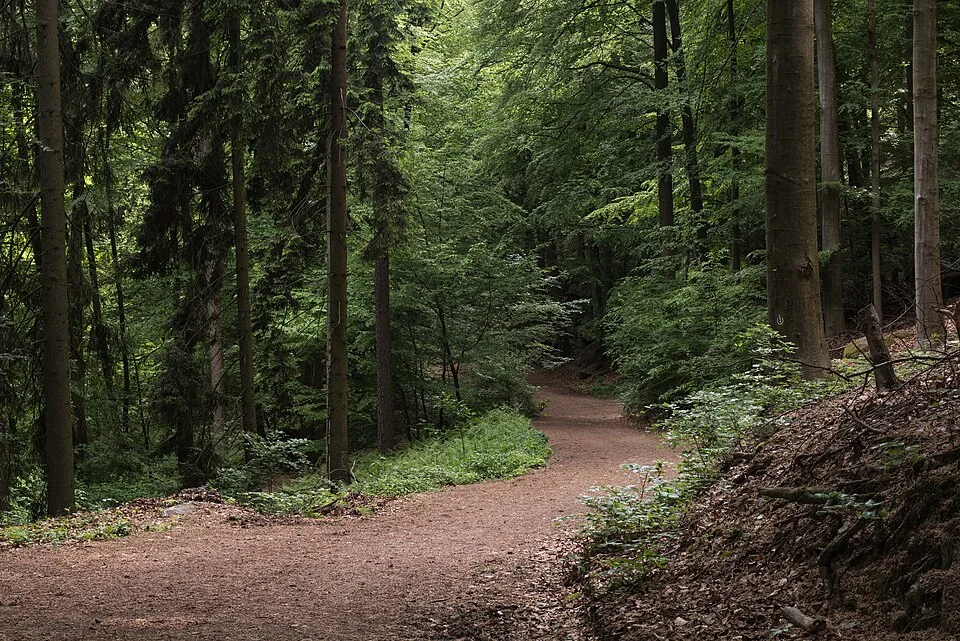
Photo: Denis Zastanceanu · Lautertal (Odenwald) · Wikimedia Commons · CC BY-SA 4.0 · Cropped display Image: Forest path in the Odenwald – mindful and safe hiking.
I have found it helpful to prepare hikes calmly and stay open to changing conditions along the way. Here I share personal experiences and ideas that help me, from an easy hike to a multi-day mountain trip.
Anticipation without pressure
For me, a good break leaves room to notice my surroundings. Not every hike needs a personal record or a published route. Time outside balances my days at a screen; sometimes a familiar forest, an open view and time for a pause are enough.
Privacy matters to me
Komoot can help me plan a trip, but I do not publish my personal routes, start and finish points or current locations on this website. I prefer to share landscapes and topics that can be enjoyed without a movement profile. Not every beautiful moment needs a location pin or a post on the internet. some things can remain a personal memory.
Planning with room to adapt
I look at distance, elevation gain, difficulty and paths in advance, leaving time for breaks and a margin. When useful, Google Earth gives me a first impression of the terrain and landscape. Images can be old and cannot reliably show current trail conditions, so I also use current maps and local information.
Navigation and power
Before setting off, I download maps and a suitable route to my phone for offline use and carry a power bank. On longer or remote walks I also like to take a paper hiking map as an independent backup. Checking signs and my map helps me keep my bearings when there is no signal.
Weather, clothing and breaks
Before starting I check the weather, available daylight, trail conditions and regional warnings; I also watch for changes along the way. Protection from rain, wind and cold belongs in my pack, as do enough water, some food, such as fruit or vegetables, energy bars or dried fruit, sun protection and a headlamp. I adapt what I carry to the route, season and terrain. When conditions are not right, I would rather turn back or change my plan.
Footwear and walking poles
I choose footwear to suit the terrain and conditions: an easy path may call for different shoes than a rocky, wet or alpine route. Before a longer trip, I break in new shoes on shorter walks.
I use walking poles according to the route: they give me extra support on ascents and can ease the strain on descents. I make sure they suit me and the terrain.
Drinking water on the trail
Before a trip I consider how much water I need and where I can refill along the way. I check whether the water is safe to drink and do not assume every spring or hut will have water available.
Local knowledge and hut registers
For me, regional warnings and local notices take precedence over general website information. Before setting off I like to ask local people, hut hosts or local experts about paths and weather: they know their home region and can better explain current conditions. Their advice complements my own preparation and official warnings.
On hut-to-hut walks, where a hut or trail register is provided for this purpose, I enter my next planned destination. If my plans change, I let the hut or someone I trust know when possible. Before I start, I share my route and expected return time with someone.
First aid and emergencies
I carry a small first-aid kit; on suitable trips I add an emergency blanket and an Israeli bandage. This specialised pressure dressing can help treat a heavily bleeding wound and, depending on the injury and its location, can also be self-applied. I find it important to practise using it in advance on a first-aid course. I also carry skin-friendly tape so I can tape pressure points on my feet as soon as I notice them.
In an emergency I call for help as early as possible and give assistance within my training.
Video about the Israeli bandage ↗
Walking together
When a region is new to me or I lack experience, I find it especially helpful to walk with experienced companions or a guided group. A shared pace, open communication and the option to turn back make a trip more enjoyable for me.
Membership of an Alpine club can be a good way for me to meet people for trips, attend courses and use planning resources. I would check the benefits and insurance terms with the relevant club or section beforehand.
Insurance cover is another important consideration for me. Subject to its conditions, the German Alpine Club’s Alpine Safety Service lists up to €50,000 for search, rescue and recovery costs after an accident or mountain emergency; this can include helicopter operations. Since a rescue can be expensive, I check the requirements and exclusions before a trip.
In a covered case, the benefits may also include medically appropriate and reasonable repatriation. I also check whether my trip needs additional cover, such as travel health, liability or legal expenses insurance. I read the current terms to see what applies and what needs to be arranged separately.
Getting started in mountain sports with the German Alpine Club ↗
Being considerate outdoors
I share the landscape with other people, animals and plants. I stay on suitable paths, respect local rules and protected areas, and carry my rubbish back out. That leaves me room to experience the landscape attentively and at my own pace.